
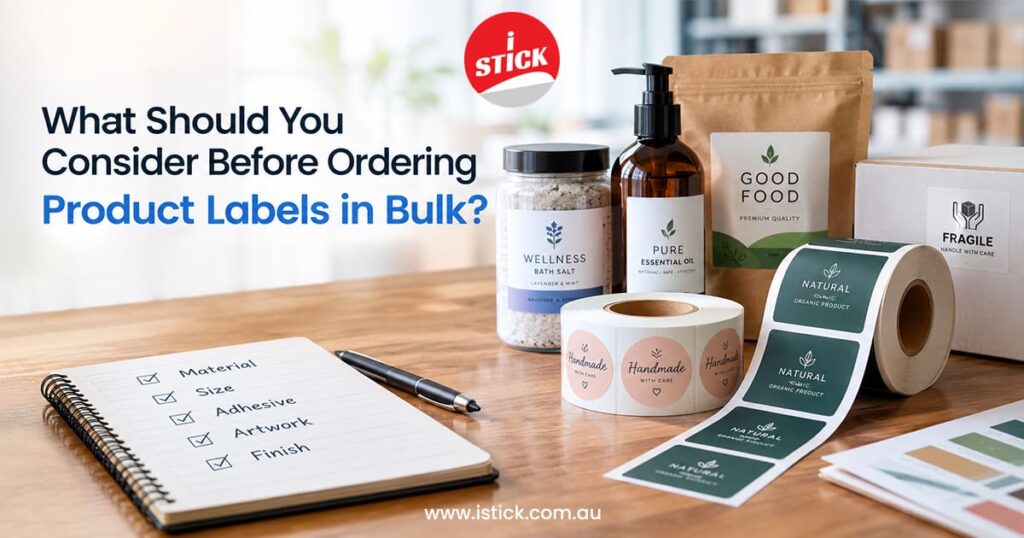
Ordering product labels in bulk can make sense when you have a growing product range, regular production runs or a large number of products to package. Buying larger quantities can help keep your labelling consistent and reduce the need to place frequent small orders.
But before committing to hundreds or thousands of labels, it is worth getting a few important details right. The label material, size, adhesive, artwork and finish all need to work with your product and packaging.
A little planning before product label printing can save you from costly mistakes later. Here are some of the main things to consider before placing a bulk order.
Work Out How Many Labels You Actually Need
Start with your expected product output rather than simply choosing the largest quantity available.
Look at how many units you currently produce or sell and consider how that figure may change over the coming months. If you have several products, calculate the label requirements for each one separately.
It is sensible to have some extra labels available for damaged packaging, application mistakes or unexpected increases in orders. At the same time, ordering far more than you need can create problems if your packaging or branding changes.
For a new product, a smaller initial order may give you more flexibility. Once you know the product is selling consistently, ordering product labels in bulk becomes easier to plan.
Think About How Your Product Will Be Labelled
Before choosing your labels, look closely at the packaging. Is it a bottle, jar, box, pouch, bag or another type of container? Is the surface flat, curved, textured or uneven?
The shape and material of the packaging can affect how a label sits and how well it stays attached.
A label that works perfectly on a smooth cardboard box may not perform in exactly the same way on a curved plastic bottle. Considering the packaging first makes it easier to select a suitable label material and adhesive.
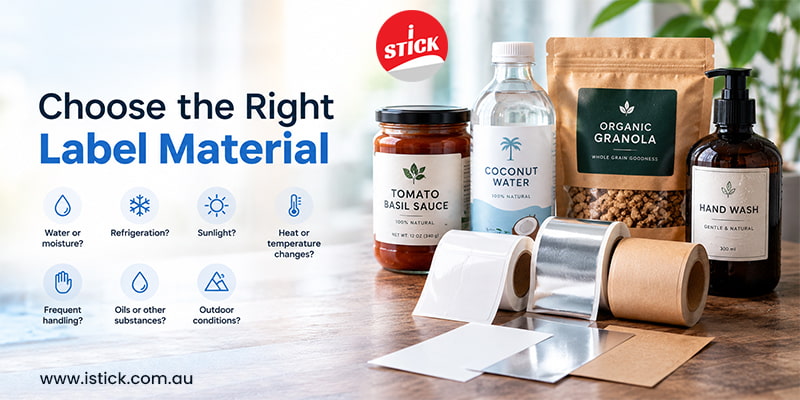
Choose the Right Label Material
The material you choose should reflect how and where your product will be used.
For products kept indoors in dry conditions, paper labels may be suitable for many applications. Products exposed to moisture, frequent handling or outdoor conditions may require a more durable material.
Think about what your product labels will experience after they leave the printer.
Will they be exposed to:
- Water or moisture?
- Refrigeration?
- Sunlight?
- Heat or temperature changes?
- Frequent handling?
- Oils or other substances?
- Outdoor conditions?
There is no single label material that is right for every product. Choosing based on the actual application is more useful than simply selecting the lowest-cost option.
Get the Label Size Right
Size can have a surprisingly big impact on how your finished product looks. The label needs to fit comfortably within the available area without covering important packaging elements. At the same time, it should provide enough space for your branding and essential product information.
Measure the actual packaging before finalising your label dimensions.
If the container has curves, edges, lids or seams, take those areas into account as well. A label that looks correctly sized on a computer screen may not look the same once it is applied to the physical product.
For businesses with multiple product sizes, it may also make sense to use different label dimensions rather than forcing one size to work across the entire range.
Make Sure Your Artwork Is Ready
Before sending artwork for product label printing, check every detail carefully.
Spelling mistakes, incorrect product names or outdated contact information can become expensive problems when you are ordering labels in large quantities.
Check your:
- Logo
- Product name
- Ingredients or product information
- Website address
- Contact details
- Barcode or QR code
- Product size or quantity
- Colours
- Label dimensions
Also check that your artwork meets the printer’s file requirements, including resolution, bleed and safe areas.
If you are unsure about any part of the artwork, it is better to clarify it before production begins.
Consider How Much Information You Need
A product label needs to do several jobs at once. It should represent the brand, identify the product and provide any information customers need. Depending on the type of product, this could include ingredients, instructions, warnings, quantity, batch information or other relevant details.
The challenge is fitting everything into the available space without making the label difficult to read.
Avoid filling every part of the label simply because there is room. A clean layout with clear hierarchy is often easier for customers to understand.
Think about what someone needs to know first, then organise the remaining information around it.
Choose a Finish That Fits Your Brand
The finish can change the overall appearance of your product labels.
Gloss can give labels a bright, vibrant appearance, while matte can create a more subtle and refined look. Other materials and finishes can be considered when you want your packaging to have a particular appearance or feel.
Think about the product and the brand before choosing.
A bold, colourful food product might benefit from a different finish than a minimalist skincare or candle brand.
If you are unsure, testing a sample before committing to a large order can help you see how the material and finish look on your actual packaging.
Check the Adhesive and Application Surface
The adhesive is another detail that should not be overlooked.
Labels need to stay attached to the packaging throughout the product’s expected use. The surface, shape and environment can all affect adhesion.
Before placing a large order, consider whether the label will be applied to glass, plastic, cardboard, metal or another material.
It is also worth considering how the labels will be applied. If you are labelling hundreds or thousands of products by hand, the label needs to be easy to position accurately and consistently.
Testing a sample on the actual packaging can help identify potential problems early.
Think About Your Label Application Process
How you apply the labels can influence the format you choose.
If labels are being applied individually by hand, you may have different requirements from a business using a faster packaging process.For larger production runs, the way product label stickers are supplied can become particularly important. The right format can make it easier to handle and apply labels consistently.
Think about who will be applying the labels, how many products they need to label and how much time the process takes.
A label that looks great but is awkward to apply can slow down your packaging process.
Consider the Cost Per Label
One of the main reasons businesses consider bulk product label printing is the potential to reduce the cost per label.
However, don’t compare suppliers based only on the headline price.
Look at what is included in the quote, such as:
- Quantity
- Material
- Label size
- Shape
- Finish
- Adhesive
- Printing quality
- Production time
- Delivery
A cheaper label is not necessarily better value if it does not perform properly on your packaging.
It is more useful to consider the overall cost and suitability of the finished label.
Order a Sample Before Going Large
If this is your first time ordering a particular label, getting a sample can be one of the most useful steps you take.
Apply it to the actual product and look at it from different angles. Check the colours, text size, finish and overall appearance.
Then leave it in the conditions it is expected to experience.
Does it stay firmly attached? Does the material look the way you expected? Is all the information easy to read?
These checks are much easier to make before committing to a large print run.
Think About Future Product Changes
Finally, consider how long you expect to use the same label design.
If your branding, packaging or product information is likely to change soon, ordering a very large quantity may not be practical.
This is particularly important for new businesses that are still developing their product range.
For established products with consistent branding and reliable sales, larger orders can be easier to justify. For newer products, ordering a manageable quantity first can give you room to make improvements later.
Make Your Bulk Product Label Order Count
Ordering product labels in Australia is not simply about choosing a design and deciding how many you want. The best result comes from considering the entire process — from your packaging and label material to artwork, adhesive, finish and application.
Taking the time to test your labels before placing a large order can help prevent unnecessary waste and ensure the finished product looks and performs as expected.
For businesses with established products, product label printing in larger quantities can provide consistent branding across the range while making packaging easier to manage.
Whether you need labels for a new product or are replenishing an existing range, choosing the right material, size and finish from the beginning can make your bulk order a much more straightforward process.